The best of all possible worlds
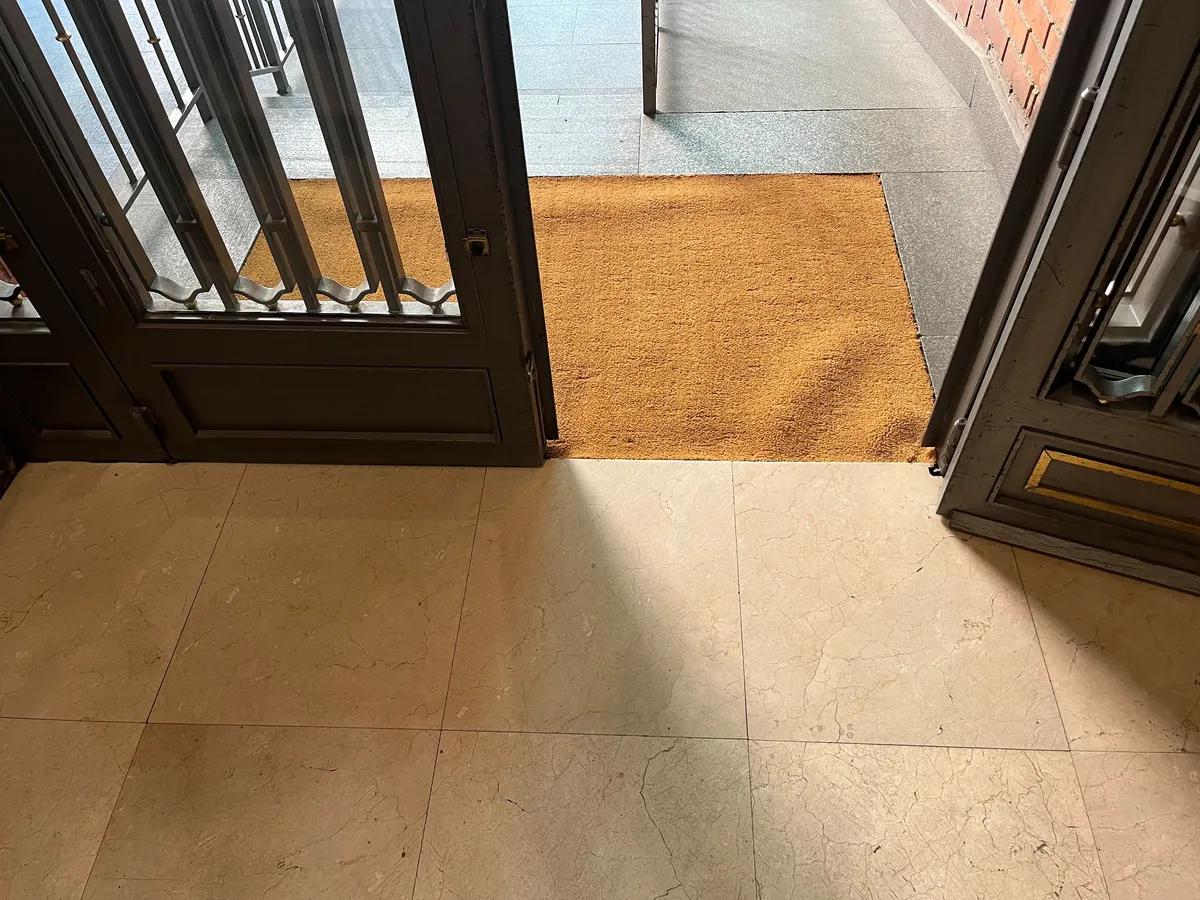
The day before yesterday, a transoceanic lad turned up carrying the new doormat for the work entrance. He plonked it down in front of me, asked me to sign for the delivery, and then scarpered.
Putting down a doormat involves no difficulty and requires no knowledge, experience or special tools: this is the case with many tasks that are now called low-skill. It is these low-skill tasks that represent the explicit and implicit functions of my job, which consists of taking care of everything that does not require knowledge, experience or specialist tools.
The point is that almost everything is low-skill until problems arise. It is perfectly normal for them to arise, and for someone to have anticipated the hitch and have an efficient solution already thought out and prepared.
Our doormat had been cut too wide, and when the edges were pushed into the corresponding recess, air pockets bulged up. The remedy would have been as simple, easy, quick, precise and cheap as the seller sending a worker with the right tools, who had fitted it himself and corrected the excessive width by trimming a narrow strip off the longitudinal edge in just two minutes.
Instead, the doormat had to remain with the air pockets while the caretaker (low-skill and, logically, not authorised to take any moderately important decision) had to locate the vice-president of the residents’ association so that he could make the obvious decision (one that only he had the authority to take at that moment). In the end, the vice-president himself turned up several hours later and spent another hour trimming the entire length of the doormat with a utility knife and a pair of scissors.
Perhaps the shop cannot afford a post-sale installation service, perhaps the buyer (the residents’ association in this case) cannot afford to pay for that service, or perhaps both. In any of the three cases, the situation ought to be called misery, but no one calls it that — not even those who lived and prospered in the situation immediately before, which was better.
One might have expected, as a positive side effect of our markedly ageing demographic profile, that at least the dominant older generation would serve as witnesses to the ageing, impoverishment and degradation of everything basic in the lower and majority layers of the population — the rich, of course, live insulated from general prosperity or misery, and in their world everything always works perfectly.
But here we are: many older people, aged 55 to 70 (the generation immediately preceding the entrenchment of systemic misery and malfunction) are having none of it. Instead of confirming anything, they do nothing but extol their own superiority, presenting themselves as the part that was truly better, while it is the young (meaning the core and vanguard of today’s active working population) who, according to the still-active older generation, are what has deteriorated.
Thus, the testimony of the still-active older generation, to their own greater glory, becomes complicit in the whitewashing and greater glory of the Eliphaz, Bildad and Zophar of our time. According to these glorious citizens, everything is fine, except for those who are not fine; and if these people are not fine either, it is entirely their own fault — most probably because they are lazy and slack, vagos, flojos.
The evident misery — avoidable in our era, therefore a misery on purpose — has become the elephant in the room that no one points out.
Such a panorama led me to reflect on Leibniz’s the best of all possible worlds, on the guilt that each person bears for what happens to him (linked to the premise of free will), on the necessity of everything that happens (linked to the definition of God), and on the idea of those divinely chosen (who would be free to save or condemn themselves, yet, in the eyes of an omniscient God, are as predestined as everything else). I also thought about the notion that God gives us signs of His existence and of the plan He has for the world and for each one of us…
And I thought that all these ideas I had been reflecting on, which I have just listed, were already contained in medieval Catholic theology. I thought how accurate Chesterton’s verdict was: that in that orthodoxy these great tensions — along with many other no less profound and pressing ones — fitted into a well-measured and subtle equilibrium, still full of mystery but astonishingly rational.
Heresies, Chesterton concluded, were nothing but ways of taking one of those known and ancient tensions and carrying it to the point of nonsense.
Let us see an example.
In accordance with orthodoxy, God created man free to choose between good and evil and to save himself — thus, with the indispensable help of divine grace… This equilibrium, problematic and full, we repeat, of the inevitable mystery that always and necessarily surrounds these most radical and important questions, could be broken either by dislodging the idea of human freedom, or by dislodging the idea of divine omnipotence. The heresy of Pelagius (4th–5th centuries) consisted in the former; that of Lucidus (5th century), Gottschalk (9th century) or the Reformation of the 16th century consisted in the latter.
Der liebe Gott steckt im Detail, would say a German proverb: God is in the detail. And certainly, as we would say at present, so too is the devil.
The idea of the best of all possible worlds is not, in its essence, original to Leibniz, nor is it optimistic in the cretinous, contemporary sense of the word — just as one cannot consider the idea of the Apocalypse of Saint John pessimistic, unless it be wrenched from the doctrinal whole to which it belongs.
(See Optimism and longevity.)
Nihil est sine ratione — the principle of sufficient reason restates one of those ideas well situated in the delicate equilibrium of orthodoxy. Its optimism consists in the belief that everything, indeed, will eventually make sense.
But believing that everything has a reason does not mean that we should greet everything that happens as if it were equally good. For (although this is what the God in whom such optimism believes would do — the God of Genesis who creates and sees that everything created is good, and indeed, more than good: effectively the best possible),
we are not God.
We have, unlike Him, a limited vision. To claim that everything, no matter what happens, should seem equally good to us, would be nonsense, dishonesty: a misuse of the freedom God has given us to judge and choose, trusting in the perfection of His plan, but also acting to the extent that we can — limited by God for reasons He knows and we do not.
The matter is, of course, tremendously complex and thorny, and it could only generate in many minds a great many non sequiturs and distortions.
One such distortion produced the Poem on the Lisbon Disaster. Examination of the Axiom: ‘All is Well’, in which Voltaire presented the earthquake of 1 November 1755 (All Saints’ Day) as if it were a flaw in Leibniz’s central idea — as though Leibniz had forgotten that earthquakes and many other very grave disasters exist in the world, and we had all had to wait, along with Leibniz, blind and naïve except for Voltaire, for an earthquake to occur so that Voltaire could then enlighten us with the dazzling and profound conclusions of his Poem and Candide.
The world has always been a vale of tears, and all theodicies — including, of course, those of Alexander Pope and Leibniz — had taken this into account when they said that the world is necessarily what it is because Providence has ordained it so. There was much evil and much pain before the Lisbon earthquake, even before Auschwitz, even before Adorno and Voltaire.
It seems obvious to me that there are two possible perspectives on the interpretation of evil, suffering and error in the world, and this approach should be formulated, or at least borne in mind, when addressing the question of the best of all possible worlds without falling into the straw man fallacy, as well as the other fallacy mentioned above and so many others.
And what makes one choose one position over another?
To summarise, the best of all possible worlds includes human beings as they are (as they — according to that theodicy — were created in the best possible way), human beings cannot know the world absolutely and completely and therefore cannot know the world whose course has already been written and that will necessarily happen — in the best possible way.
Recognising the world as something necessary and determined, and understanding (and above all, Believing — and Hoping, and Loving) that it is the best of all possible worlds, is not an invitation to stand still saying:
‘Ah, how wonderful the best of all possible worlds is!’
or,
‘Ugh, how little I like the best of all possible worlds!’
Maybe the fact that we discern, aided by faith, the necessity and perfection of the Whole, also includes the fact that we discern what — within our limited perspective — appears clearly as good and what appears clearly as improvable, and maybe it includes the fact that we should do as much as we can — within our limited capacity and through our free will: mysterious, incomprehensible free will, to us — so that the best of all possible worlds may become better, insofar as we are presently able to recognise what is better.