On my birth
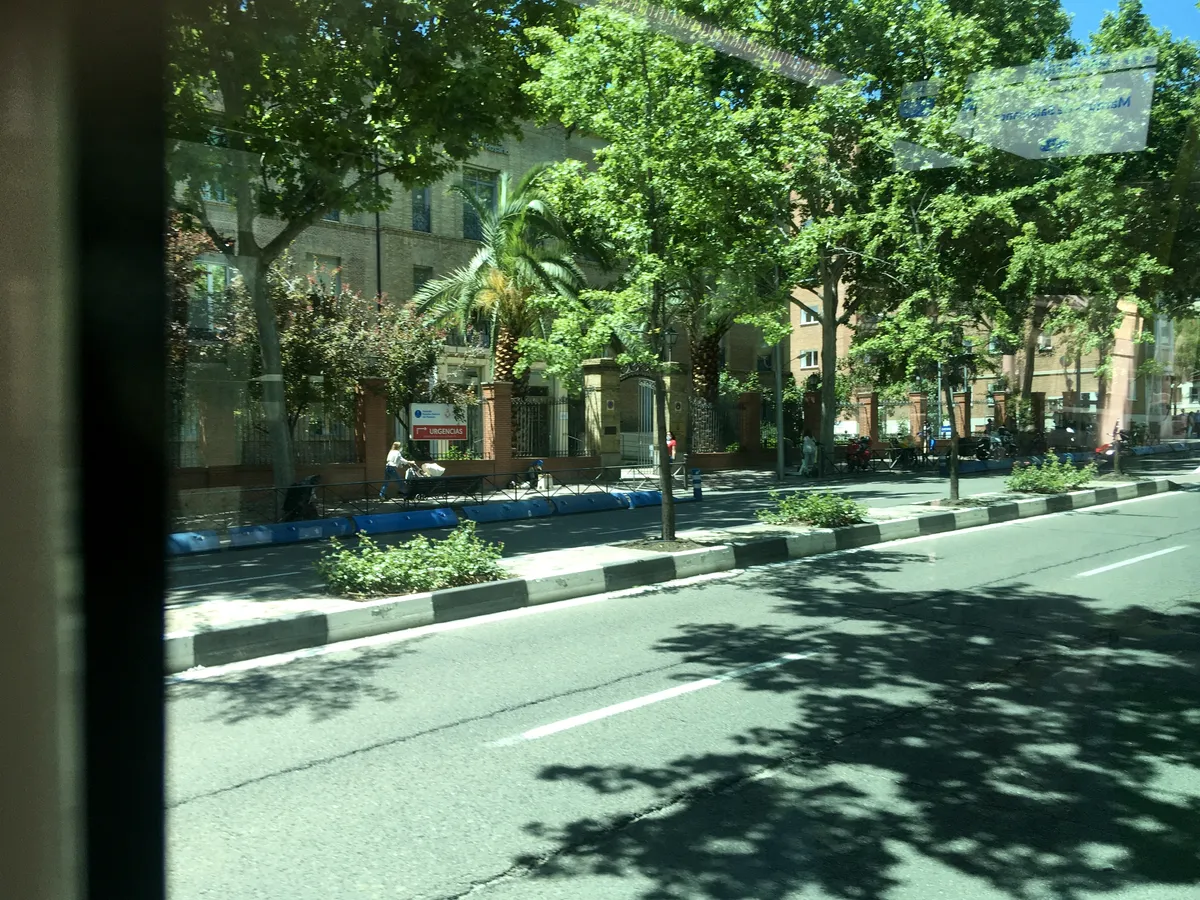
I was born on 24 April at three o’clock in the afternoon, in Madrid, Spain, at Hospital Nuestra Señora del Rosario, where one of the nuns donated blood compatible with my rare blood group — A negative — to save my life. Shortly afterwards, the street reverted to its former name: Príncipe de Vergara.
(The header photograph shows the hospital at the very same time of day. I took it from a bus on Thursday, 24 June 2021, as it passed along the same street.)
The doctor had told my mother that, despite being thirty-eight, the fact that she had already had two children meant my birth would not be problematic and there was no need to take any special precautions. He was wrong. He later apologised.
I would arrive late from the very beginning. I was born after ten months and with numerous problems. They put me in an incubator, gave me tubes, and countless injections. I have always attributed to that experience the deformity of my skull profile and my severe myopia — no one on either my father’s or my mother’s side of the family has ever had eyesight problems or needed prescription spectacles.
My aunt — the wife of the Galician paratrooper, who lived on the magical thirteenth floor of the M-30 Beehive, designed by architect José Banús, after whom the Marbella marina was named — always spoke with amazement at the total lack of complaints with which I bore the sheer gravity of the situation.
Doctors had given up hope, to the extent that a priest came to give me Extreme Unction.
At some point during that ordeal, the need for a blood transfusion arose. That, too, proved difficult.
The only compatible donor in the family was my father, who was disqualified due to his heart disease. Those of us with blood group A negative can only receive A negative and O negative blood, which were in short supply (at least in that place and at that moment). And then the nun came forward.
*
My father was a son of a well-off family from Santander. He was a veterinary surgeon and always wore a suit — that is what I saw with my own eyes. I held the photographs and the diploma itself: a thick, ivory-coloured document from the 1950s in pristine condition, with the official seal and the signatures of the relevant authorities. It bore my father’s name as Licenciado en Veterinaria, specialising in Nutrition, awarded by the Complutense University of Madrid.
My mother used to tell me that he had made an important discovery related to in vitro fertilisation, but that his habitual carelessness, disregard, or clumsiness in worldly and practical matters had prevented his discovery from receiving the significance it deserved.
He was responsible for my inexplicable middle name and for the choice of the hospital, where my belated birth and my first struggling days passed. He died three months later and I never lived any of that well-dressed life.
From the unanimous testimony of everyone who knew him, I gather that I am uncannily identical to my father. I must be my father deprived of the proper context, my father in vain — my father for nothing, and with a less remarkable nose. And with the maternal green beneath the brown branches of my iris.
My mother used to say that she did not care what her third son looked like, nor how much he resembled his father; she only prayed that he would not inherit his father’s nose. Judging by the outcome, her prayers seem to have been answered.
Besides being a veterinary surgeon, a great traveller, always in a suit, reputedly gifted in Latin and mathematics, and possessor of a remarkable nose, my father was an avid reader. I sometimes imagine him reading Quevedo’s sonnet to a nose, whose verses interpret the large nose as a sign of Góngora’s supposed Jewish ancestry. My father would have smiled and remarked to Quevedo, just as he had remarked to my mother (or so she told me), that in his case the nose was a thing of the North. The north of Spain, more precisely the Basque-Cantabrian region.
Influenced by these observations, I would eventually sketch an anthropology of the Basque-Cantabrian man, to whom I restored his atavistic name of montañés (mountain dweller, Highlander). Its predominant traits (though neither necessary nor sufficient) would be the remarkable nose and Rh-negative blood — whose unusual prevalence had already been noted by researchers, albeit only within the present-day Basque Country.
It has been said that Basque women resemble Scottish women, so my atavistic nomenclature would not be entirely whimsical in its Caledonian resonance either.
The whole idea arose from the fact that my father’s family were from the Northern Spanish Highlands, although my father himself had been born in Madrid. My mother, for her part, was also born and raised in Madrid, but as far as I know her entire family was likewise from Madrid. She did not have a good opinion of the Santander Highlanders. She used to say that they were false, that they had two faces, and that trait was cynically represented by a two-faced statue in a mountain pass at the entrance to the region. (It must be taken into account that my father’s family was wary of her, they did not behave well, and she ended up fed up with spending every summer in their land.) If my father’s family were conservative but hostile to Franco (because, as I was told, during the Civil War the Nationalists had thrown one of their relatives down a ravine), my mother, quite the opposite, would go on to become a member of the Socialist Party in the 1980s, but it was not unusual to hear her speak of Franco with approval and even nostalgia. She admired, for instance, his habit of spending his summers in San Sebastián under the threat of ETA, as well as the way he had dealt with Hitler at the railway station in Hendaye.
Everybody says that Santander — traditionally known as La Montaña: the Highlands — is incredibly beautiful. I have never been to Santander.
As for the land of the Basque Highlands, I can say that I was once in Bilbao. I was really awestruck as the bus entered the Basque Country. Isolated farmhouses in the midst of dazzling greenery, the feeling of height when passing through the forests, a remote sky of impossible colours. There one is certain of not being in just any place.
*
My parents lived in several flats in Madrid. One of them (before I was born) was in Parque de las Avenidas; the last one, on Calle de Santa Susana in the Hortaleza neighbourhood: when he died, she managed to keep it, along with the yellow Renault 12 repainted white (many years before the Opel Kadett that appears in other posts), both inherited after legal battles with my father’s family.
My mother was refused a widow’s pension. She was married to my father when he died, her children bore his surname, my father had spent his entire working life in research and animal nutrition… but the civil servants told her, as she told me on several occasions, that she was entitled to nothing. They ended the conversation with:
‘Get a job, madam. You’re young.’
This whole account, as told by my mother, now sounds really improbable in retrospect. What I can personally attest to is that my siblings do indeed bear my father’s surname; that the personal and financial circumstances were dire; that my mother took me to events (organised by the College of Veterinary Surgeons?), though I do not know whether they were specifically for widows, orphans, or both, where the children were given a present at the end (I do not know whether the mothers received one as well); and that my mother really did have to find work as a matter of urgency.
The job emerged in Móstoles, where her cousin lived and in whose town hall her cousin’s husband knew people. The council hired her as a cleaning lady, and she bought the flat we moved to.
All my classmates in that town had a village. On weekends, they all used to go to their villages (al pueblo) with their families. I asked at home why we didn’t have a village. Finally, I decided that our village would be the Hortaleza flat, where my mother and I used to spend some weekends.
Endless buses passed by. There were more buses than people, and more bus stops than buses. The street was always sad. I remember it prosaically autumnal. I have not been to that street in ages. According to Google Street View, it still looks the same.
*
My mother’s last words were my brother’s name. I heard it in person. I was nineteen years old at the time. He was thirteen years older and, as I said one day, he was born from my mother’s previous relationship with a man who was and still is completely unknown to everyone but my mother. Her bond with my brother was one of difficulty, adoration and devastating final disappointment with him, especially following the appearance of the woman who would be the mother of my brother’s children, and with whom, years later, he would end up bitterly estranged.
I have nothing but gratitude for everything my mother did for me, entirely on her own, working as a cleaner and taking care of all the household chores. Yet she always seemed to do it out of duty alone, as if obeying a Kantian imperative.
A very clear illustration of this was her cooking.
Fried chickpeas with onion were a genuine rarity: this traditional leftover dish, made from the chickpeas left over from cocido madrileño, was something she always made superbly, even though the whole secret of the dish lies in being patient with the caramelisation of the onion, stirring constantly for half an hour while making sure it neither collapses into an undifferentiated mush nor loses the individuality of the chickpeas, which should retain a slight crunch, and serving it with lettuce dressed only with salt, vinegar and raw olive oil.
As a child I knew none of these details; I knew as little about cooking as I knew about everything else. It is only now that I know something about cooking, and about other things too, that I can recognise how anomalous that delicacy really was — not merely because it was exquisite, but above all because it rested almost entirely on patience.
Set against the exception those chickpeas represented, my mother’s culinary rule became glaringly obvious through the different versions she produced of Spanish omelette and chips. On days at the swimming pool, the omelette was exactly to my taste; on any other day, it was nothing of the sort. I even attributed magical powers to the pool. Only many years later did I notice the far simpler and more prosaic coincidence: her firstborn never came to the pool with us.
Nor had I noticed the still more obvious explanation for the different versions of her chips. When my brother came home in the small hours after his extra job as a DJ, my mother would serve him a main course accompanied by an enormous dish of soft, gleaming potatoes (the kind that are slowly cooked for half an hour over a medium heat before going into any sort of omelette). All my life I asked for the soft, gleaming potatoes, and not once did she make them that way for me — or for us, or for anyone, unless her firstborn was among the expected diners. Mine were ordinary potatoes, dry, fried quickly over a high heat. Decent potatoes: nourishing, entirely within a mother’s duty. They were Kantian potatoes. If ever I asked for the nice ones, as I did for the pool omelette at home, she would say that she had no idea what I was talking about, and that she always made them exactly the same.
*
I never accepted not having been the most beloved thing in the world for my own mother, even though all parents have a favourite child among their children. It was not an abnormal event nor my mother’s fault, but it was not my fault either.
The person for whom I was the most beloved thing in the world had died before I could assimilate such a privilege and remember it. I was three months old. And I did not even grow up knowing it by hearsay: what I was told was that I had been an unwanted child, an accident.
It was not until my mother died that through my brother — who didn’t know that I didn’t know anything — I learnt that I had not been an accident, but the very opposite: the son my father wanted to have with my mother, whose other two children were from another father, or fathers, nobody knows.
Some of my mother’s decisions and quirks were difficult to understand. Her life must have been extremely tough. Shortly after becoming a widow, she had to hear her daughter say in the heat of an argument: I wish you had died instead of him (my father).
My sister adored my father. One day, I said that perhaps I was lucky because, having never met him, I had never had to suffer the grief of losing or missing him either. She replied:
‘You don’t know what you’re talking about. If you had met him, you’d know that meeting him would have made even the greatest suffering worthwhile.’
The surname matter has already been mentioned. Besides, he used to buy my siblings things at the kiosk so they could go to Mass with him; he enrolled them in the best schools… (When he died and everything was lost for everyone and my siblings ended up at the school I would later attend, their teachers said they were at a level two years above what was expected for their age — despite the fact that they were intelligent but not at all diligent students.)
My father was fifteen years older than my mother. She had me when she was thirty-eight, so he would be fifty-three. He died at fifty-three of a heart attack. He had been told that an operation was available with a very high risk of death, but that death would follow soon afterwards if the operation were not performed. He decided against the operation.
I was three months old. Doctors ran extensive tests on me and concluded that I did not have the heart disease my late father had.
Thirty years later, I received a call informing me that doctors had discovered a heart problem that affected and would inevitably affect all the men in my paternal family. I was told that they all died of the same cause, but that a safe surgical procedure is now known that practically eliminates the risk — nothing like the one that existed in my father’s time.
I have not yet consulted a doctor to fully clarify my situation and to have the appropriate measures taken. Nor am I aware of ever having suffered any heart symptoms or warning signs. Anyhow, I have no plans to do anything in this respect.
The age of fifty-three had never seemed so far away to me as it does now that I am chronologically closer to it than ever before.