Do your magic with rubbish! (Haz tu magia con los residuos) [July, 2025]
My first task of the day is to collect the wheelie bins (taken out the night before and emptied by the refuse lorry). This can be very quick and easy, or it can completely embitter your life.
Months ago, I used to spend ten minutes every morning looking for the bins around the place, often in vain because a homeless person or a caretaker from another block of flats had stolen them.
— In that case, you have to order more bins from the city council (and pay for them - at the building’s expense). They usually take two or three days to deliver them. In the meantime, you’d better have spare bins (and a place to store them).
Fortunately, this stopped happening. I started finding the bins near the building and in plain sight.
Afterwards, the constant ordeal has been that people put rubbish in the bins first thing in the morning.
Faced with this possibility,
— you can take the bags out and leave them on the pavement (a dirty expedient that also carries a fine) or — put them in bins outside another block of flats (passing the problem on to another worker);
— you can leave the bins as they are, on the street (which also carries a fine);
— you can leave the bins at the entrance (if your building has a gated entrance before the lobby), and again, you’d better have extra bins if the others are full; and the gated entrance might smell bad, depending on what rubbish had been thrown into the bins (after hours);
— you can take the bins to the bin room, which is accessed through the entrance hall: in this case, the entrance hall or even other areas inside the building could be affected by the stench.
— — In all cases, you’ll need to take out twice as many bins the following evening (if you have any), collect them the next morning (praying the problem hasn’t recurred and multiplied), and clean them.
*
In the middle of this constant ordeal, one day an intriguing and providential bin appeared with the hand-lettered words:
‘Dental clinic.’
No one has picked it up yet, not even once; it sits there abandoned and functions as a universal receptacle for all those bags of after-hours rubbish in the bins of all the buildings in the area. A respite. (Although, naturally, it is not the ideal situation: the ideal would be for no one to put rubbish in the bins in the morning—after hours.)
*
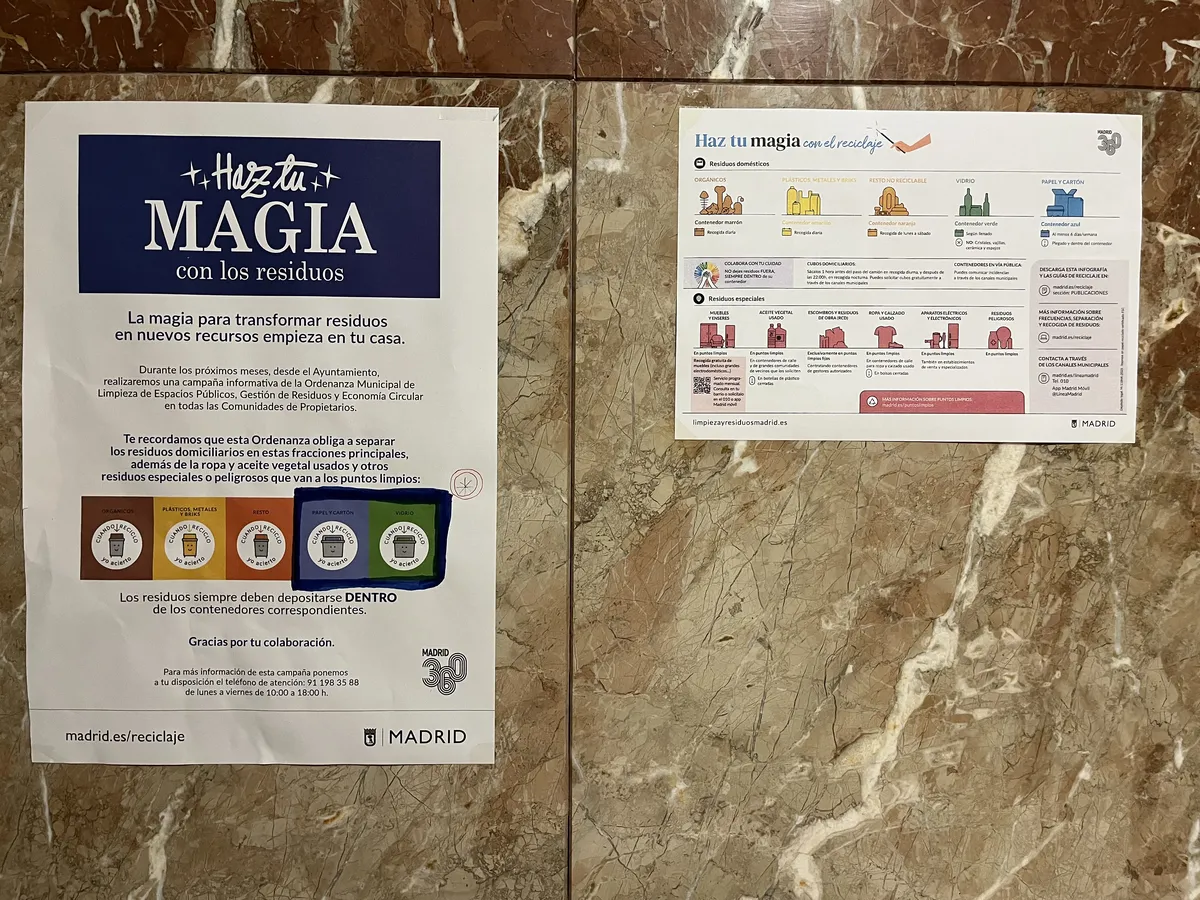
The period of calm had only been roiled by a visit from ambassadors of a recycling awareness campaign titled (in the posters they brought):
‘Do your magic with rubbish!’
They announced imminent inspections of the wheelie bins to monitor the placement of different types of rubbish in their corresponding bins, designated by the colour of their lids.
It won’t be a problem while they inspect the bins in the room, but once I take the bins out onto the street, I cannot control what people put in them. I hope the authorities take this into account.
*
Today, a woman from the dental clinic came to tell me that a man had called them to complain about the situation with the 24/7 universal rubbish bin (‘Dental clinic’), which everyone fills and no one ever picks up, assuming the hand-lettered words ‘dental clinic’ indicated the bin belongs to their clinic.
It doesn’t, and therefore they have no reason to worry even if the guy on the phone makes good on his threat to report the fact to the police.
But even if it were not possible to find out who owns the bin, someone from the city council might show up to take it away, so in the end, it’s me, as usual, who does have reason to worry, because, to my regret, I have no magic powers to obliterate either the rubbish or people who dump it where and when they shouldn’t.
*
The first time I found myself in the morning with a bin filled to the brim, stuffed with open or torn bags (a sure sign of homeless people in search of food), with a pile of loose waste scattered around the inside of the bin, I had no idea what to do.
I just wanted to cry, and the only thing I knew for sure at that moment (apart from the appropriateness of a sudden, fulminating heart attack) was that the bin full of rubbish wasn’t going up to the bin room (not only because of the stench, but also because of the guaranteed appearance of bugs and the risk of infection).
What I did was choose a secluded spot and dump the entire contents there.
A few minutes later, two police officers arrived in response to a call reporting what had happened.
I told them, more or less, what I have been explaining in the preceding paragraphs.
They told me they didn’t know of any solution to my aporia (they did not use this word), but that leaving rubbish in public spaces is a punishable offence regardless of the causes and circumstances. And that the bins must be put away thirty (?) minutes after being emptied by the lorry.
— Of course, that sounds perfect. But what time does the lorry come by here? Does it even have a fixed time? Are you telling me that, in addition to my nine-to-eight job (with the — long — midday break), I have to spend the night waiting for the lorry, in order to collect and put away the bins as soon as the lorry empties them?
— Of course, they didn’t answer.
They said they would speak with the caller to see if he would finally file a complaint against the building or not.
He could have done so successfully, since I, in my infinite rage, had admitted to the police from the very beginning that I had indeed been the one who had overturned the bin on the public street.
The complaint never came.
*
Months later, a week-long strike of rubbish collectors broke out, which didn’t cause me any problems — on the contrary: the situation was similar to usual, except that for once I was exempt and able to do my work in peace.
*
On 11 March 2026, I found the rubbish bins lying upside down.
The manoeuvre may have been accidental; equally, it may have been deliberately devised and carried out by the worker responsible for emptying the bins into the lorry.
The fact that it has never happened again strongly suggests that the bins were left upside down by accident after all.
At the time, however, I instinctively saw it as an ingenious and generous act by the worker — a view that I consciously chose to embrace. Seen in that light, the manoeuvre became a touchstone for many of the reflections that followed.
On the very day I found the bins upside down, I published a tweet with my optimistic interpretation.